

AI Agent Excellence
AI Agent Excellence: When Humans and Agents Run the Business Together
Imagine you wake up on a Monday morning and your business has already made a thousand small decisions before the first coffee: customer emails drafted, supply exceptions resolved, invoices reconciled, sales proposals tailored, risks flagged, approvals routed, and next-best actions queued.
No one “worked late.”
The work moved — because a combined human-and-agent workforce executed it.
That shift is arriving faster than most leadership teams are prepared for. Not because the technology is impressive (it is), but because it quietly changes the complete operating reality of the firm: where execution happens, where value is created, where risk sits, and what “good management” needs to look like.
What is Agentic AI?
Agentic AI is the next generation of Artificial Intelligence technologies that doesn’t just generate outputs or recommendations, but plans and executes work end-to-end to achieve business outcomes — within clearly defined goals, permissions, controls, and governance.
Agentic AI refers to AI systems designed to pursue a defined objective, make decisions, take actions, and coordinate across multiple steps of a process, rather than responding to prompts or supporting isolated tasks. In practical terms, agentic AI shifts AI from “assistance” to execution: agents can trigger actions across systems, follow process logic, collaborate with other agents and humans, handle exceptions, and escalate when judgment, approval, or accountability is required.
Critically, agentic AI operates within defined boundaries — with explicit rules, access rights, audit trails, monitoring, and human oversight — so that autonomy increases without compromising control. In a business context, this means agents becoming part of the company’s execution engine: improving cycle times, throughput, and quality; reducing manual effort and rework; and increasing consistency in how processes are run. Because agents can scale execution quickly, the shift is fundamentally transformative—and it makes governance, operating model design, and value management essential to ensure reliability, compliance, and measurable business impact.
What is AI Agent Excellence?
As work increasingly happens through a combined human and AI agent workforce, excellence in how those agents operate becomes a business-critical capability. AI Agent Excellence brings Operational Excellence into a world where humans and robots run your business.
“AI Agent Excellence is about optimizing
how humans and AI agents work together
to run end-to-end business processes
And deliver the outcomes
that shape your customer experience.”
In practice, AI Agent Excellence is the discipline of making AI agents a reliable, governed, and value-driven part of everyday execution — focused on the agents that truly matter, applying proven best practices, and ensuring ROI materializes in real performance, achieved with people rather than at their expense.
And because agent-driven execution scales quickly, it also requires codifying best-practice processes, principles, policies, and strategic intent for agents to execute against — backed by governance, controls, and early-warning mechanisms that preserve alignment and human control as execution scales.
“A world of increased Human-Agent Collaboration.”
Because agent-driven execution scales quickly, it also requires codifying best-practice processes, principles, policies, and strategic intent for agents to execute against — backed by governance, controls, and early-warning mechanisms that preserve alignment and human control as execution scales.
This is not a “tech topic.” It is operational excellence in an agent-driven execution model — with a new type of workforce.
The shift: from “people using tools” to “a Diversified workforce running processes”
Most organizations still think in a familiar pattern: people execute work, and tools support them. Agents flip that logic.
Work increasingly shifts from isolated tasks to end-to-end process execution, where agents can coordinate across steps, hand off to each other, and operate at machine speed—while humans provide judgment, oversight, and accountability where it matters.
In that world, the core leadership question changes from:
“How do we implement tools?”
to
“How do we run the business when execution is shared between humans and agents?”
Three modes of execution leaders must design for
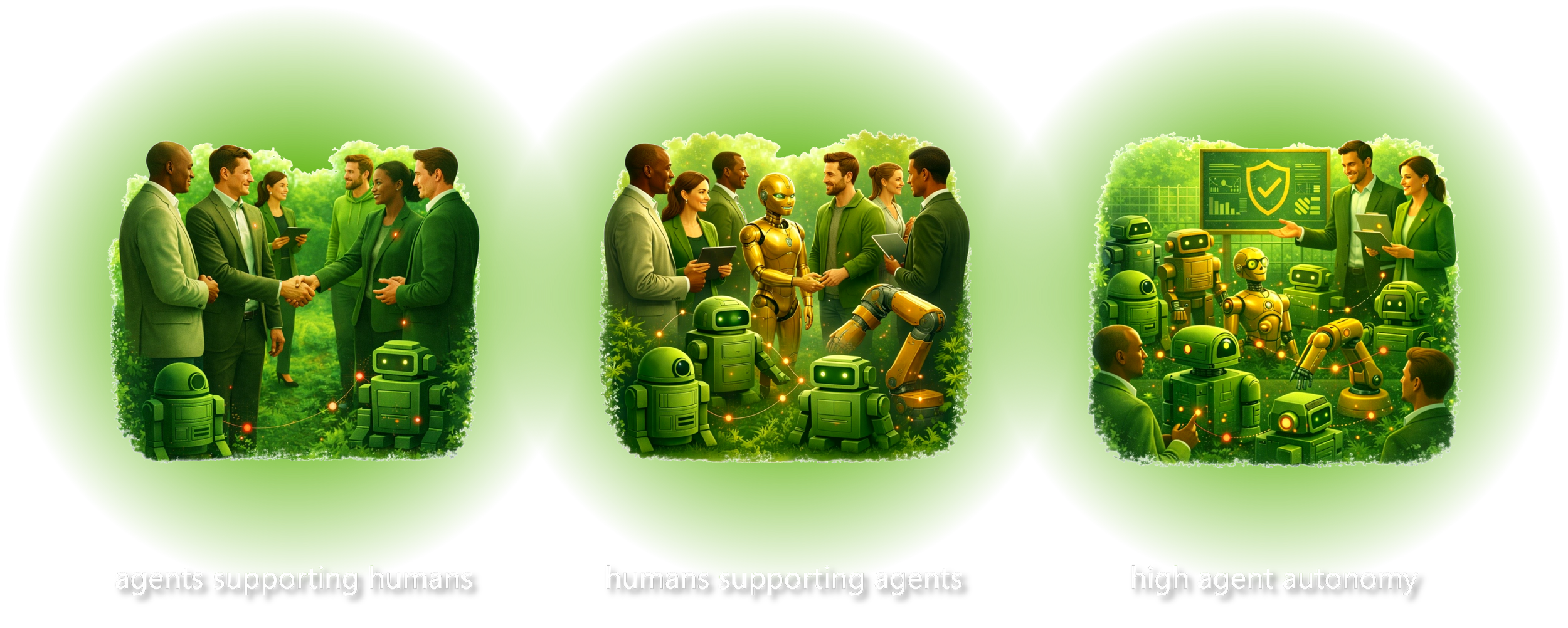
In reality, organizations won’t move to “fully autonomous” overnight. Execution evolves across three modes that will coexist:
Humans supported by agents
Agents augment productivity and decision-making — speeding up preparation, analysis, drafting, and routine coordination.
Agents supported by humans
Humans stay in the loop through oversight, exception handling, escalation, and judgment — especially where customer impact, financial exposure, or reputational risk is high.
Autonomous agents (within boundaries)
Agents execute defined processes end-to-end—inside clear governance and control limits—where performance is proven and risk is controlled.
The leadership task is not to “pick one.” It is to orchestrate all three — and continuously move work to the right mode as confidence, controls, and performance mature.
Governing agent-driven execution without slowing Down the business
When execution scales, governance can’t be a separate bureaucracy. It must be part of normal operations — fast, embedded, and outcome-based.
High-performing agent governance typically looks like this:
Codified business intent: agents execute against clear principles, policies, decision rights, and process standards — not improvisation.
Guardrails, not handcuffs: autonomy is bounded (what agents can do, approve, spend, commit, and escalate).
Outcome accountability: accountability shifts from individual actions to system-level outcomes (cycle time, quality, compliance, customer experience, loss leakage).
Early-warning signals: leading indicators surface drift, risk, and value leakage early—so humans intervene quickly and decisively.
The goal is simple: keep execution fast, while preserving control, auditability, and strategic alignment.
Agent Control, especially in Multi-Agent Execution (System Stability & Drift Prevention)
In agent-based operating models, execution is no longer linear. It emerges from a network of humans and agents, often involving agent-to-agent interaction, delegation, and autonomous orchestration. When autonomous agents trigger or steer other autonomous agents, the system can quickly become sensitive to misaligned parameters, incomplete policies, or incorrect optimization signals.
If left unchecked, such systems can drift into undesired states of execution: reinforcing suboptimal behaviors, creating silent compliance breaches, degrading customer or consumer experience, or amplifying risk without immediate visibility. These effects are rarely caused by a single agent “failing,” but by systemic interactions across agents operating at scale.
For this reason, Agent Control is a core pillar of AI Agent Excellence. It ensures that autonomous execution remains stable, intentional, and reversible, through a balanced combination of preventive guardrails, early-warning detection, and controlled intervention mechanisms. Agent Control enables autonomy without surrendering accountability, and scale without losing control.
Making AI agents deliver measurable outcomes — and sustained ROI — at scale
CFOs and COOs don’t need more activity. They need performance and financial results.
Sustained ROI comes from managing AI agents like a value and performance portfolio—governed with the same rigor applied to cost, risk, and operational excellence:
Start with a clear value thesis tied to the P&L (cost-to-serve, working capital, revenue leakage, cycle time, quality, risk).
Establish baselines before scaling.
Deploy agents only where they materially change the economics of end-to-end processes.
Assign a single accountable business owner per use case.
Define outcome KPIs (not activity metrics) embedded in the normal operating cadence.
Then institutionalize value assurance:
Prioritize use cases by impact and controllability.
Stage-gate scale decisions against observed results.
Monitor leading indicators for drift, compliance exposure, and value leakage.
Keep humans in the loop where judgment, exceptions, and reputational risk matter—and expand autonomy only as controls and performance prove reliable.
That’s how agent adoption becomes what it must become: measurable outcomes, governed execution, and sustainable ROI.
Grounding and Priming as a Continuous Control Mechanism
For agents to act correctly, responsibly, and consistently, grounding and priming must be treated as a continuous lifecycle discipline, not a one-time setup activity. AI Agent Excellence operationalizes this discipline across three moments in an agent’s life:
Design-time grounding — defining intent and boundaries.
At design time, agents are grounded in the organization’s intent by anchoring them to best-practice processes, policies, compliance criteria, risk thresholds, and decision principles. This grounding establishes a shared understanding of what “right behavior” means before any execution begins and defines the boundaries within which autonomy is allowed.Build-time priming — shaping decision behavior.
During development and configuration, agents are primed using authoritative, high-quality sources and systematically tested against known failure modes, edge cases, and risk scenarios. Priming at this stage ensures agents internalize how decisions should be made, not just which tasks to execute, and that rules and processes are interpreted consistently.Run-time grounding — guiding execution in context.
During execution, agents remain grounded by continuously referencing the relevant process context, applicable policies, and decision thresholds for the situation at hand. Rather than relying solely on generative reasoning, agents use explicit business context as orientation, keeping execution aligned even as conditions change.
Together, grounding and priming turn agents from reactive executors into governed participants in business execution. They reduce behavioral drift, prevent unintended optimization, and make autonomous execution scalable — while preserving control, compliance, and trust.
Agent Control: Managing Agent-Driven Execution as a Living System
As agents become an integral part of business execution, control cannot be reduced to static rules or after-the-fact checks. Agent-driven execution requires active controlling — the ability to continuously see, steer, influence, and correct how work is performed across a hybrid network of humans and agents. This controlling function must operate in real time, at scale, and as a combination of automated, semi-automated, and human-led mechanisms.
At the foundation of agent control lies radical transparency. At any point in time, organizations must be able to understand where risk exists, where it does not, and how agent-driven execution is affecting business outcomes. Even when everything appears “green,” a controlling system must make deviations visible: emerging risk indicators, unusual agent behavior, declining business KPIs, rising exception cases, or early signals that execution is drifting away from intent. This transparency enables flags and early warnings, ensuring that the right people — or systems — are alerted before small issues turn into systemic failures.
Building on this transparency, effective agent control combines three tightly integrated management and control mechanisms:
Preventive guardrails — shaping behavior before execution.
Preventive mechanisms define and enforce the boundaries within which agents are allowed to operate, embedding policies, decision logic, permissions, and ethical or regulatory constraints directly into execution. These boundaries do not merely restrict agents; they actively guide them, ensuring that certain actions are impossible by design and that autonomy unfolds only within clearly intended limits.Detective transparency — continuously sensing and interpreting signals.
Detective mechanisms go beyond simple monitoring by actively interpreting execution signals across agents, processes, and outcomes. They detect when behavior, performance, or risk indicators begin to diverge — whether this shows up as quality degradation, policy deviations, rising exception volumes, or unexplained KPI movement — and correlate those signals back to agentic execution patterns.Corrective interference — intervening, stabilizing, and learning.
When deviations occur, corrective mechanisms enable immediate stabilization: automated self-correction where possible, controlled intervention where necessary, and targeted human involvement for judgment-intensive situations. Crucially, correction operates on two levels — restoring the operational outcome and addressing the systemic cause that produced the deviation. This ensures the system does not merely recover, but improves.
Taken together, these mechanisms form a controlling system for agent-based execution, analogous not to a dashboard, but to a flight control system. It allows the organization to keep execution stable in motion, respond safely to incidents, and continuously refine the underlying systems, processes, and rules that govern autonomous behavior. This is what makes it possible to run a business with autonomous agents — not by watching them, but by actively steering the system they operate in.
The real point: AI Agent Excellence is a Value-Driven (leadership) capability
AI agents don’t just change tasks. They change how execution works — and that forces a rethink of:
operating model and accountability,
governance and controls,
performance management and incentives,
workforce design and skills,
and ultimately how strategy becomes execution.
Organizations that treat this as a capability — built deliberately, run with discipline, and improved continuously — will compound a sustainable competitive advantage. Those that treat it as “some automation” or think that “throwing money after technology is the solution” will get fragmented implementations, rising risk, and disappointing outcomes.
