

Business Transformation
Imagine you walk into a room with twenty experienced professionals. Different roles, industries, and transformation battle scars.
You ask one simple question: “What is transformation?”
You will most likely get answers about data and platforms.
About marketing and social media campaigns.
About operating models and processes.
About culture, mindset, and customer experience.
Innovation, governance, automation, talent, architecture and AI — all make an appearance.
You start counting.
By the time everyone has spoken once, you already have more than twenty answers. If you let the discussion run, you might easily end up with forty. And if you ask the same group again tomorrow morning, chances are the answers will shift — just slightly, but noticeably.
Not because anyone is wrong.
But because transformation is broad, multi-dimensional, and shaped by perspective.
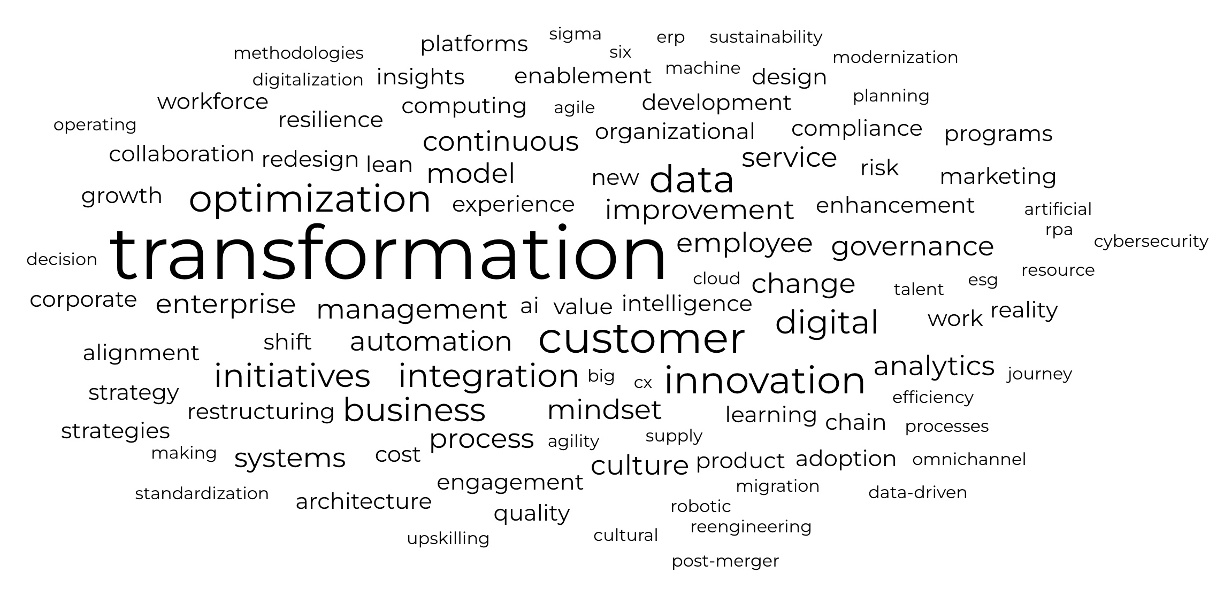
Transformation isn’t one thing.
That’s why a simple question rarely leads to a single definition.
It leads to many valid answers at the same time.
Not a clear sentence — but a cloud of words.
So, what does transformation mean for you?
What Transformation Is Not.
Transformation comes in many forms — but it is also one of the most frequently misused words in business. Many initiatives that are labeled “transformation” are, in reality, tactical responses to specific problems. They may be important. They may be necessary. But on their own, they are not transformation.
Cost cutting and restructuring often create short-term benefits and visible P&L impact. But they are rarely sustainable. When executed without a clear strategic intent, they can destroy capabilities, erode trust, and hollow out organizations — creating organizational debt similar to technical debt. The numbers may improve temporarily, but the long-term ability to grow, adapt, and perform often suffers.
Technology implementation modernizes tools, not outcomes. Implementing software does not automatically change customer experience, address new market realities, or create financial value. Without changes in behavior, processes, and decision-making, technology remains a back-end upgrade — frequently requiring significant time, money, and effort while delivering limited return. When investments are poorly chosen or execution is weak, technology can even become a competitive disadvantage.
Change management is essential — but it is not transformation by itself. Real change management is not communication plans, emails, or training schedules. It is about behavior, mindset, emotions, and organizational psychology. It helps people move, adapt, and commit — but only when it is tightly integrated with strategy, operating model, and capability changes. On its own, it supports movement; it does not define direction.
All of these elements can — and are more or less often — part of a transformation. But none of them, in isolation, constitute transformation.
They are necessary, but not sufficient. They are one-dimensional answers to multi-dimensional challenges.
Transformation is Also not a project, Not a program, And Not an initiative.
It is not something that can be launched, managed, and closed — it unfolds continuously and reshapes how an organization thinks, decides, and executes over time. Transformation has a continuous nature, doesn’t end and requires enduring capabilities across the organization, not temporary structures built to deliver a one-off result.
What is Transformation?
Business transformation reshapes how an organization creates value.
It realigns strategy, operating model, leadership, and execution so the business can compete, perform, and adapt under new market conditions.
It connects strategic intent to everyday execution.
Business transformation translates ambition into coherent action across people, processes, data, and technology — ensuring that what leaders decide is what teams actually do.It changes behavior, not just structures.
By aligning incentives, decision rights, skills, and ways of working, transformation embeds new behaviors and capabilities into the organization’s daily rhythm.It builds sustainable performance, not temporary improvement.
Business transformation strengthens the organization’s ability to deliver results repeatedly — creating resilience, scalability, and long-term value rather than one-off gains.
In essence:
Business transformation turns strategy into a living system of execution — one that continuously evolves, delivers measurable value, and keeps the organization competitive over time.
Introduction: The Logic of Transformation Layers
Business transformation is not the optimization of isolated functions. It is the deliberate redesign of the system of value creation. That system is made up of distinct but tightly interconnected layers — from strategy and people to processes, data, and technology.
The transformation layers provide a way to structure complexity: they make explicit where change happens, how impact is created, and why isolated initiatives rarely deliver lasting results. True transformation occurs when these layers are intentionally aligned and orchestrated toward a common strategic outcome.
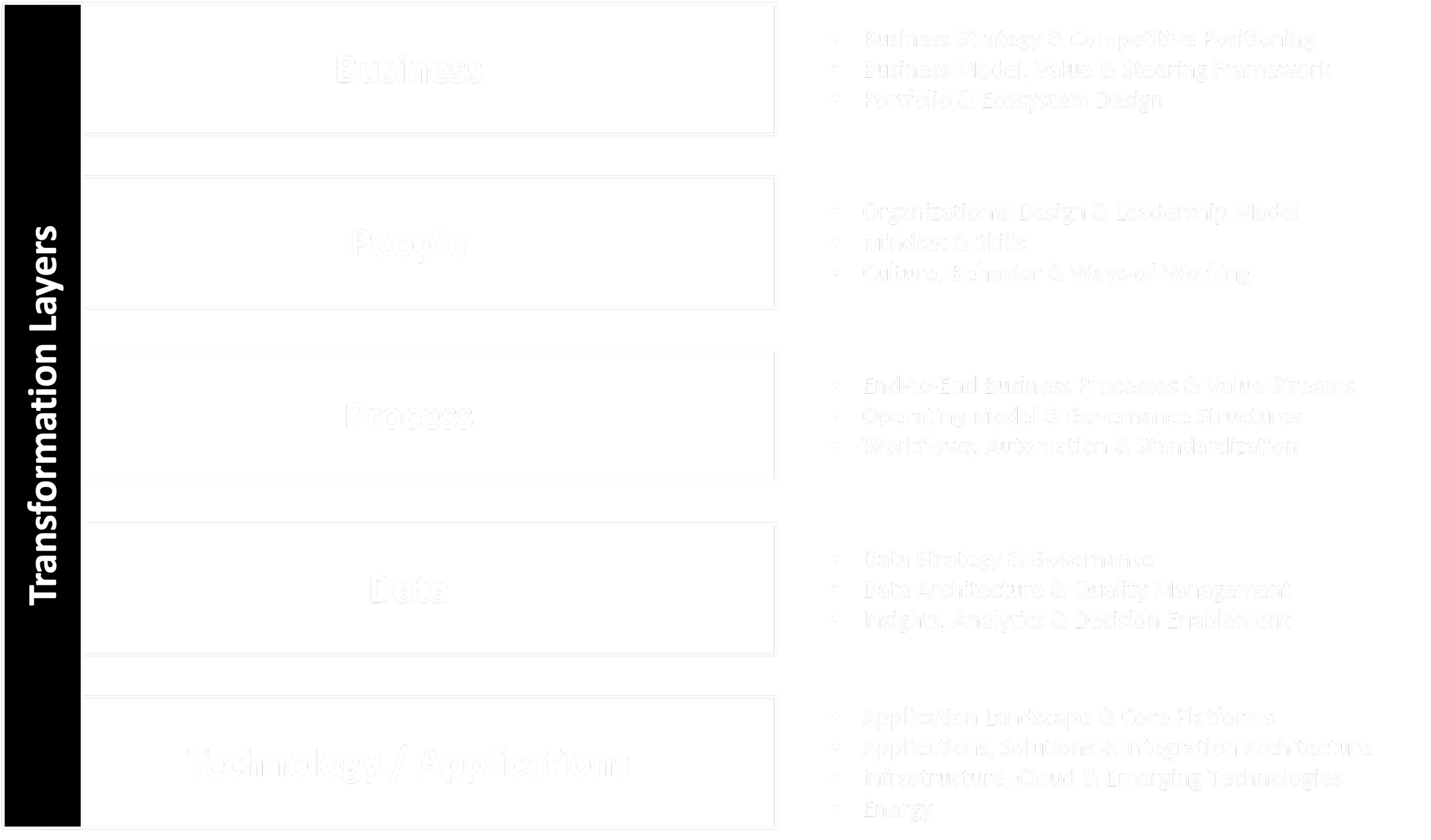
What makes a transformation truly transformative and impactful?
Holistic orchestration across layers
Strategic altitude of change
Cross-layer coherence
Top-down direction and bottom-up adoption
Clear line of sight to business value
The Layers of Transformation explained.
Business
The Business layer defines why the organization exists and how it competes. It sets strategic direction, competitive positioning, value propositions, and portfolio priorities. This is where leadership decides where to play, how to win, and what economic logic the company follows.
Transformation at this layer reshapes the company’s trajectory — by redefining the business model, steering mechanisms, and ecosystem role. Without change here, all downstream efforts remain optimization, not transformation.
People
The People layer determines whether strategy can actually be executed. It includes organizational design, leadership models, skills, incentives, culture, and ways of working. This layer translates strategic intent into daily behavior.
Transformation succeeds only when people understand the direction, feel ownership, and are enabled to act differently. Culture, mindset, and leadership behavior are not “soft topics” — they are decisive execution levers.
Process
The Process layer is where value is operationalized. It covers end-to-end business processes, value streams, governance structures, and execution models. Processes determine how work flows, how decisions are made, and how efficiently value is delivered to customers.
Transformation here moves beyond local efficiency gains toward rethinking how the organization actually creates outcomes — across functions, silos, and partners.
Data
The Data layer provides the factual backbone for modern decision-making. It includes data strategy, governance, architecture, quality management, and analytics. Data connects intent with insight and execution with evidence.
In transformation, data shifts from passive reporting to active decision enablement — allowing leaders and teams to steer performance, manage trade-offs, and adapt based on real signals rather than assumptions.
Technology / Applications
The Technology / Applications layer enables scale, speed, and reliability. It includes applications, platforms, integration architecture, infrastructure, cloud, and emerging technologies.
Technology does not define transformation — but it amplifies it. When aligned with the upper layers, it accelerates execution and unlocks new capabilities. When misaligned, it becomes cost, complexity, and technical debt.
Why the Layers matter?
Transformation impact emerges across layers, not within one of them. Changes at the technology, data, or process level must reinforce strategic intent and people capabilities. Likewise, shifts in strategy or culture must be operationalized through processes, data, and systems.
Holistic orchestration across layers
– All dimensions (business, people, process, data, technology) are considered and interconnected, even if not changed simultaneously.Transformation is not the optimization of a single dimension; it is the deliberate orchestration of business, people, process, data, and technology as one system. These layers are structurally interconnected: decisions in one layer inevitably shape outcomes in the others. Even when change is sequenced over time, effective transformation designs the full system upfront and manages dependencies consciously. Fragmented, siloed initiatives may improve parts of the organization, but they do not change how value is created end to end.
Strategic altitude of change
– The higher the layer of impact (business strategy, model, culture), the greater the transformational value created.Transformation is not the optimization of a single dimension; it is the deliberate orchestration of business, people, process, data, and technology as one system. These layers are structurally interconnected: decisions in one layer inevitably shape outcomes in the others. Even when change is sequenced over time, effective transformation designs the full system upfront and manages dependencies consciously. Fragmented, siloed initiatives may improve parts of the organization, but they do not change how value is created end to end.
Cross-layer coherence
– Transformations deliver impact when changes at lower layers (process, data, tech) enable and reinforce changes at upper layers (business, people).Transformation succeeds when changes across layers reinforce rather than contradict each other. Process redesign, data capabilities, and technology platforms must explicitly enable new business priorities and desired behaviors—not operate as parallel improvement efforts. When lower layers evolve without alignment to business intent and people implications, organizations accumulate complexity instead of advantage. Impact emerges from coherent design, not from isolated excellence within individual layers.
Top-down direction and bottom-up adoption
– Leadership defines intent and direction; teams operationalize and embed it. Transformation fails when either is missing.Transformation is neither purely directive nor purely emergent. Leadership must set clear intent, ambition, and non-negotiables—defining what must change and why. At the same time, sustainable transformation depends on teams adopting, adapting, and embedding change into daily decisions and execution. Without top-down direction, transformation lacks focus; without bottom-up adoption, it lacks reality. Both are required, continuously and in balance.
Clear line of sight to business value
– Every initiative must connect back to strategic intent and measurable business outcomes.Every transformation effort must maintain an explicit connection between strategic intent and measurable outcomes. Initiatives that cannot articulate how they contribute to value creation—growth, resilience, customer impact, or productivity—remain activity, not transformation. A clear value logic enables prioritization, guides trade-offs, and creates accountability. Transformation is validated not by progress metrics alone, but by sustained business impact.
The true definition of Business Transformation
After asking enough people, ruling out what transformation is not, and looking across business, people, process, data, and technology, one thing becomes clear:
Transformation is not a one-off move.
It’s not a program you finish.
And it’s not something you ever really “complete”.
It is a continuous response to a world that does not stand still: Markets shift. Customer expectations rise. Technology accelerates. Competitive advantages erode faster than ever. The organizations that survive — and thrive — are not the biggest or the most efficient for one moment in time, but the ones that adapt best and most consistently.
Albert Einstein captured this succinctly when he said: “Intelligence is the ability to adapt to change.”
This is why Business Transformation is not separate from business itself. In many ways, it is business — viewed over time. As Simon Sinek describes in The Infinite Game, the goal is not to “win” a quarter or a fiscal year, but to stay in the game, continuously strengthening your position and and competitive advantage. (After all this is exactly what Business Strategy is all about.) Which leads to the core definition of Business Transformation:
“Business Transformation
is the continuous effort to improve
the company’s business model* vs.
the rising and frequently changing
consumer expectations,
leveraging digital technologies
(incl. Agentic AI).”
* Value Proposition and Operating Model
This definition matters because it makes four things explicit.
First, transformation is continuous.
There is no end state. No final slide. No “we’re done.” Like evolution, it is an ongoing capability — the ability to sense change, respond, and reconfigure before relevance fades.
Second, the object of change is the business model.
Not just execution in isolation, but the full system of value creation:
the value proposition and market positioning on one side, and
the operating model — people, processes, data, and technology — on the other.
Transformation happens when these move together. Changing tools without changing the business model creates activity, not advantage.
Third, consumer expectations are the driving force.
Customers vote every day with their time, attention, and money. Organizations that fail to adapt their offerings and operations to these shifting expectations don’t stand still — they fall behind.
Fourth, digital technologies — including Agentic AI — are critical enablers of this adaptation. But they are means, not the end. Their role is to accelerate learning, decision-making, and execution in service of a stronger, more resilient business model.
In this sense, Business Transformation is not a side initiative. It is the discipline of continuously renewing competitive advantage — deliberately, systemically, and at scale.
